






Story
Gender-metriosis: endo, ableism & trans healthcare

Trigger warning: descriptions of medical negligence and harm; medical misogyny
When I think of endometriosis, I think of women, pregnancy, and surgery. I don’t think of trans endo, even though 1 in 7 people with uteruses in Australia have it. And I don’t think of autistic endo, despite us being more likely to develop it.
Like most people with endo and adenomyosis, it took me 8 years of telling doctors about my debilitating pain before I was taken seriously. I was diagnosed with primary dysmenorrhea first, a medical term meaning painful periods with no cause. I’ve had many doctors tell me ‘Periods are meant to hurt’ (by many who’ve never menstruated), but there is something bizarre about your diagnosed reason for abnormal pain, being pain.
As a teenager, I quickly internalised I was overreacting, as my middle-aged woman doctor scoffed when I said my period had me laying on the bathroom floor at school. Maybe she didn’t take me literally, but her dismissal felt like an initiation – welcome to the club – from a uterus-owning elder.
I learnt to self-medicate and dissociate when pain was intense, which felt normal to do, because there were already ways I dissociated from my body to manage dysphoria and sensory overwhelm; and there were already ways I self-medicated my mental health.
I convinced myself pain was just another emotion within a mood disorder.
One day my sister saw me shut down mid-sentence and fold over onto the floor in a wave of pain. I’d forgotten to mask it. Her alarmed tone and expression took me by surprise – I’d spent so long telling myself that a display like this was just indulgent, since there was nothing abnormal about my pain.
The next day she sent me a post about someone’s endo diagnosis, and how years of dismissal by doctors left them unable to work. I remember something flickering deep in me… fear and recognition. But I finally had a word I could bargain with doctors to investigate.
The idea that people with uteruses are meant to be in pain, and there doesn’t have to be a reason why, or an outcome to address it, is the bedrock of medical misogyny. To doctors, having a uterus made the times I couldn’t stand, walk, or talk due to pain, completely reasonable.

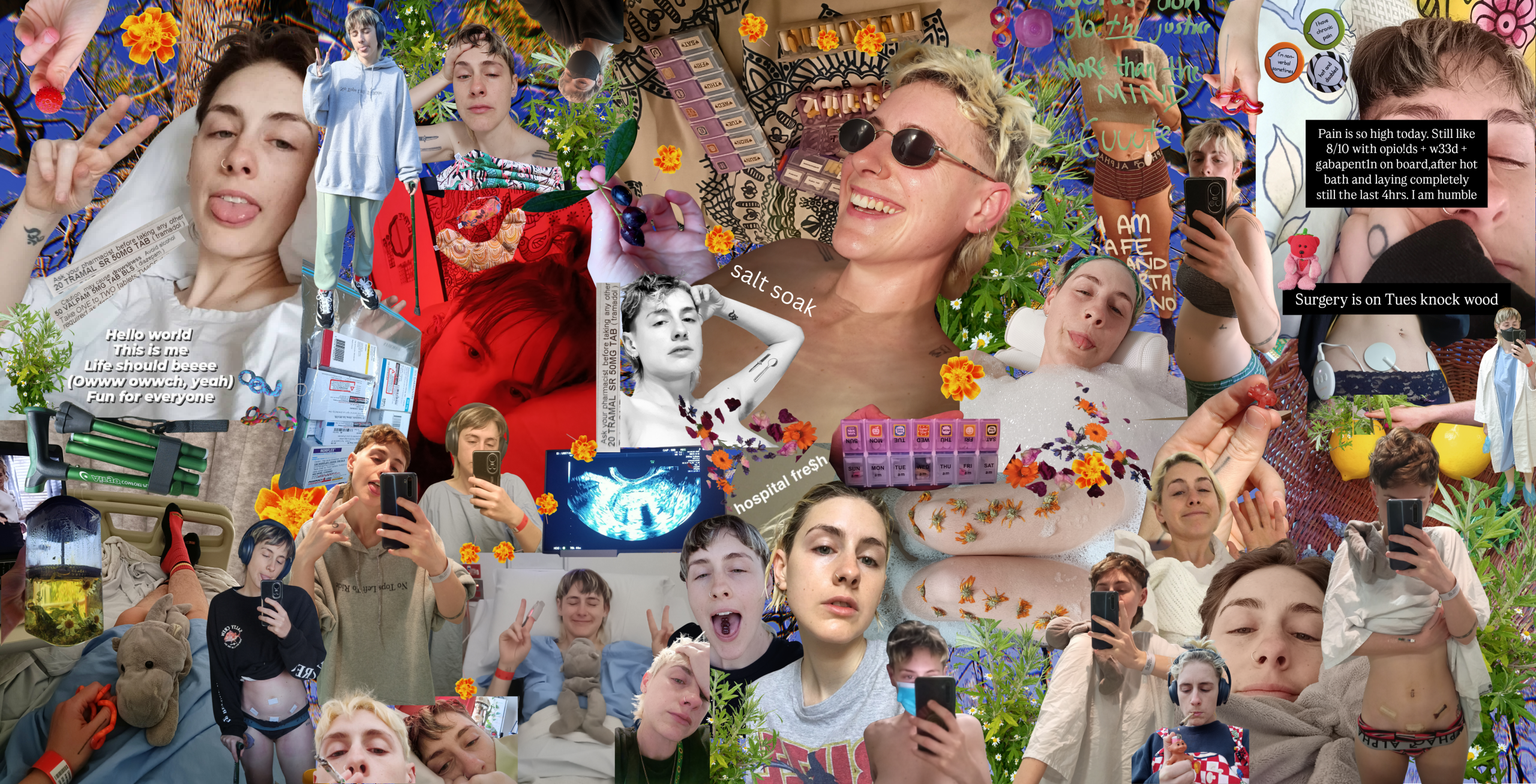
Surgery 2023
A great example of medical misogyny is the fact that doctors routinely prescribe pregnancy as a cure for endo, despite this being debunked. While pregnancy can temporarily pause symptoms by stopping menstruation, it is not a treatment – and being told to consider pregnancy to improve endometriosis severity is inaccurate and inappropriate for those who are not ready or do not want to have children.
At twenty-four, I was struggling to make rent on minimal hospo hours, managing chronic pain, and fully reliant on therapy multiple times a week. Then a male doctor told me it would be easier for me to get pregnant – and give birth and finance a dependant human for eighteen years – than it would be to just treat my pain.
Medicalisation gives doctors the power to make decisions about our bodies, while teaching us to distrust our own ‘uneducated’ bodily insights.
So, when doctors dismiss us, we’re already primed to internalise it. And the more factors that reinforce this process, such as ableism and transphobia, the harder it becomes to question medical authority.
Being in chronic pain means I’m communicating through ten layers of brain fog, but I’m expected to process and produce dense health information on the spot, to be considered trustworthy.
Being trans and having trauma from a serious medical assault mean I’m dissociated from my body every time I’m in a clinical setting – to avoid getting triggered by constant probing, but being dissociated also means I can’t truly consent. Being autistic and masking in healthcare settings means experiencing everything delayed, so I might not think of follow up questions in time, or realise that something is bad advice.
Medical ableism and transphobia both create barriers to care and cause direct harm while accessing it. In Australia, 63% of trans people have experienced verbal abuse in healthcare settings, and autistic people face six times the barriers to accessing healthcare than allistic (non-autistic) people.
It can also take time to understand an experience in relation to a systemic framework. One time, when I’d just woken up from surgery, a male nurse was changing my cannula when my smock fell, exposing my chest. He dropped what he was doing to close the curtain and left my arm free bleeding all over me. As I groggily tried to redirect him, he snapped, ‘this is for your dignity’.
At the time I couldn’t fully comprehend why it impacted me so much, I just knew I felt disgusting.
I had dark purple bruising for weeks after. The next day I was visited by the hospital’s LGBTQIA+ Liaison Officer, but it was too late to remember the right details for a complaint.

Salt soak
Over time, my distrust of the system as an accessible pathway to care became its own barrier, because I stopped believing my health mattered to anyone. It makes sense why neurodivergent trans people often burnout from our chronic health journeys much faster.
I now approach healthcare navigation like running a marathon – diligently considering pace, strategy, and resources. I use the Spoon Theory to assess and communicate how much energy I have for a day, or an appointment.
It helps me decide which spoon-spending tasks are necessary and which can be modified or scrapped.
If I’m low on spoons at the doctor because I’m in moderate pain that day, I can’t waste energy correcting the receptionist on my name, let alone pronouns. But if I’ve waited 3hrs for an appointment at the hospital, with inadequate seating, under fluorescent overheads – it doesn’t matter how many spoons I had, I’ll be unable to function by the time I’m called.
So, I pre-write all my questions ahead of appointments in a health note on my phone, to avoid thinking on the spot – and I audio record them so there’s no pressure to retain info. I also find body doubling for health admin useful, as it reduces the emotional weight. And whenever I make a health-related phone call, I pretend I’m my own personal assistant – they’re busy and in charge, with a great phone voice.
Engaging with healthcare as an autistic trans person with reproductive disease is a constant reminder that
the system responsible for us, is not designed for us.
Yet, through trial and error, and lessons from other marginalised disabled people along the way, I’ve developed a toolkit to get most of my needs met, most of the time.
I hope by sharing my story, someone else feels seen, or gleans one thing that helps them keep pushing for the better healthcare we all deserve.
About the author
Helio Caward (they/them)
Helio Caward is a trans autistic poet, disability doula, and Mad Pride advocate based in Naarm.
Keep reading

Or explore more on

We’ve got you covered
Your free Play Pack includes everything for safer sex, delivered discreetly because you deserve to focus on the fun stuff.